After a long pause, I have finally gotten around to writing the second part of Eleonor of Aquitaine’s story – now, as Queen of England.
Eleanor and Henry Plantagenet, Duque of Normandy, Count of Anjou, among other titles he possessed, were married on May 18, 1152 at the Cathedral of St. Andrew of Bordeaux. After the wedding, the couple remained in the continent defending their lands in Aquitaine, Anjou, Maine and Normandy from the attacks perpetrated by Eleanor’s first husband, Louis VII of France, and a number of his allies who considered that this marriage amounted to treason.
However, Henry needed to return to England in order to continue his fight for the English throne, to which he was entitled through his mother, the Empress Matilda, the daughter of Henry I. She taught him the principles of the art of governing and always had a very strong influence over him. In January 1153, Henry left for England and Eleanor remained in the continent, possibly living at the Château d’Angers where she devoted herself to ruling over the territories that belonged to her and her husband, while Henry divided his time between England and his lands in the continent.
During this time, she established her own Ducal Court with the troubadour Bernard forming part of her very close circle. We can still read the poems he dedicated to her in which he describes her as “noble and sweet”, “loyal” and “gracious and beautiful”.
Finally, on December 1154, Eleanor, Henry and their son, William – the couple’s first child, born in 1153 – left for England, and on the Sunday before Christmas of that same year, Henry and Eleanor were crowned King and Queen of England at Westminster Abbey. This was the beginning of Eleanor’s story as Queen of England, in London, a city that was completely different from Paris, where she had lived as Queen of France.
During the first years of their reign, Henry and Eleanor traveled throughout the whole of England and dedicated themselves – working shoulder to shoulder – to consolidating the individual provinces in the English territory in order to form a consolidated kingdom, imposing order and implementing the administration of justice. During these travels, Eleanor was able to really get to know England, a country that had been torn apart by recent civil wars.
From the very beginning of his reign, Henry was more inclined to be interested in his territories on the continent. England gave him the status of king and the income necessary to maintain peace in his continental lands. Given the constant absences, Thomas Becket was named chancellor and became Henry’s right-hand man, progressively assuming important activities inherent to the crown. This was probably not exactly to Eleanor’s liking, who had always been accustomed to governing and participating in the important decisions of government. (The story with Becket did not end well, but that belongs more to Henry’s story rather than Eleanor’s).
During the second half of the 12th century, Henry, Eleanor and their children made Westminster Palace their home, turning it into a center of courtly manners under Eleanor’s strong influence, with troubadours who came from Limousin and Poitou singing about the life and romance of the 12th century courts. They sang of Tristan and Isolde, about King Arthur and his knights, and created innumerable poems and songs dedicated to Eleanor.
Eleanor would travel with Henry from castle to castle throughout the whole of England and the continent, no matter the season of the year, and she was the king’s closest confidant and collaborator. On occasions, when Henry was away, she presided over the English court and placed her seal on certain royal decrees.
The couple had eight children. Their first son, William, died when he was still a little boy. Their other children were Henry, Matilda, Richard (the future Lionheart), Geoffrey, Eleanor, Joan and John, who would go down in history as “Lackland”.
However, things were not always happy for the couple. In 1173, their sons rebelled against their father for reasons of power. Eleanor took her sons’ side and provided them with military support. This revolt was a complete failure and she was taken prisoner by her husband, who imprisoned her and held her captive for almost 16 years. Apparently, her seclusion was not too harsh for records are still kept, which show the generous amounts spent on her clothes and the upkeep of her castles during this time. However, being imprisoned must have been almost unbearable for someone who was so used to governing and to being involved in the administration of her lands. She was released in 1189, upon the death of Henry.
When she was released from her imprisonment, Eleanor played an even greater political role during the reign of her son. She was responsible for all the preparations involved in his crowing; when he was away on Crusade to the Holy Land, she was responsible for governing the realm, and when Richard Lionheart was captured by the Duke of Austria on his way back from the Crusade, it was she who collected the money for his ransom and went herself to bring him back to England. While Richard was away, she maintained order in the kingdom, resolving and putting an end to the machinations of Lackland John and the King of France. (Enciclopedia Britannica)
Richard died in 1199, leaving no heir to the throne and John was crowned king. Once he became King, Eleanor left England and dedicated herself to governing her beloved Aquitaine, were she spent the remainder of her life.
In 1200, when she was 80 years old, Eleanor was once again on the move, crossing the Pyrenees, (we can only imagine what that must have been like for a woman her age, more than 800 years ago), on her way to Castille to collect her granddaughter Blanca to become the wife of the son of the King of France. Through this marriage, she was hoping to ensure peace between the English Plantagenets and the Capetians of France. During that same year, she helped defend Aquitaine and Anjou from her grandson, Arthur of Brittany, to ensure her son John’s inheritance in France.
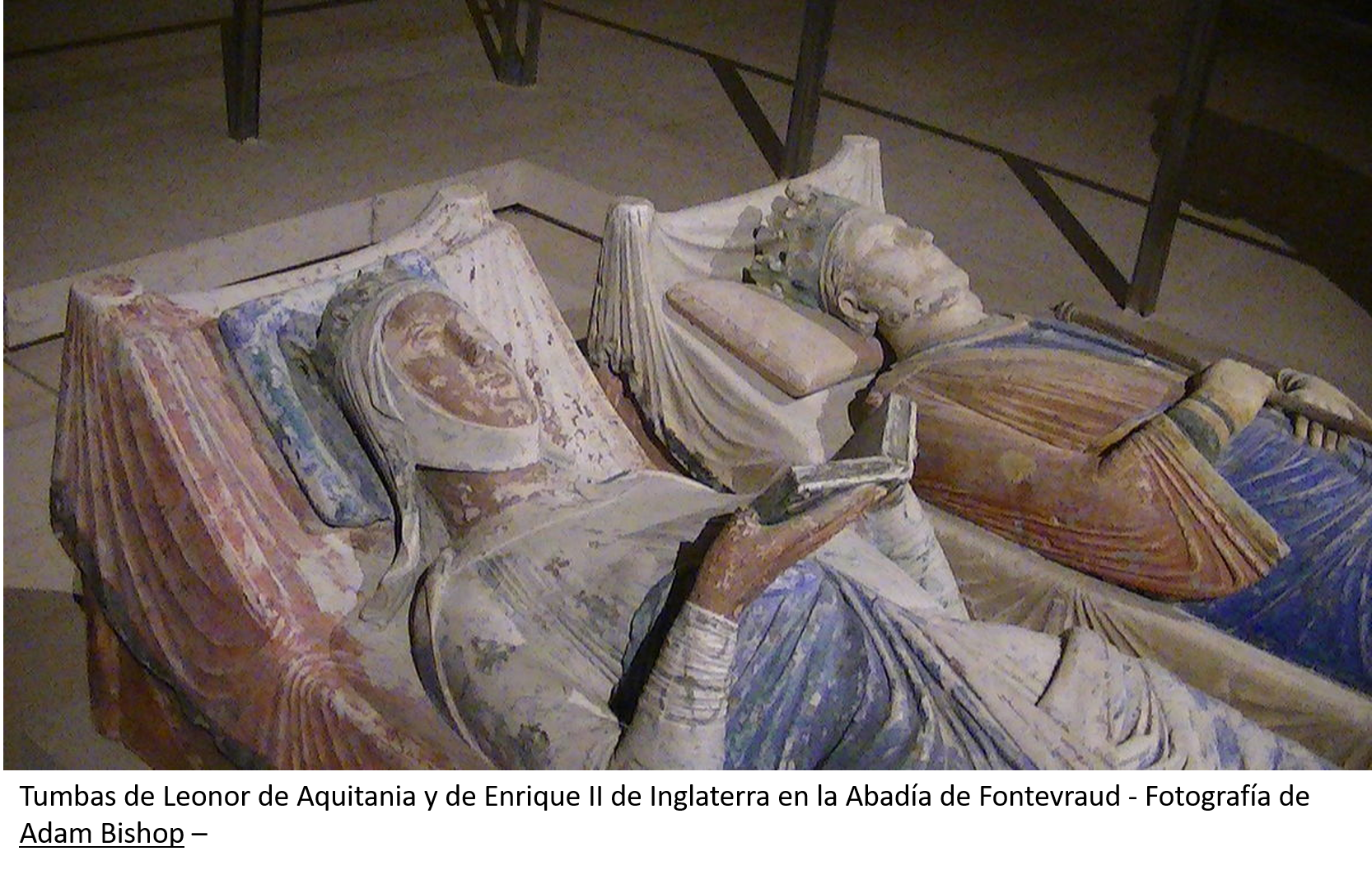
Tired after this last battle to defend Aquitaine, Eleanor retired to the abbey of Fontevrault, in Anjou, where she died in 1204. She and her husband, Henry II of England, rest together in this abbey.
The Fontevrault nuns wrote about Eleanor: “She was beautiful and just, imposing and modest, humble and elegant; a queen who surpassed almost all the queens of the world”.
 Nora's Blog... Sixty and Still Going Strong!!