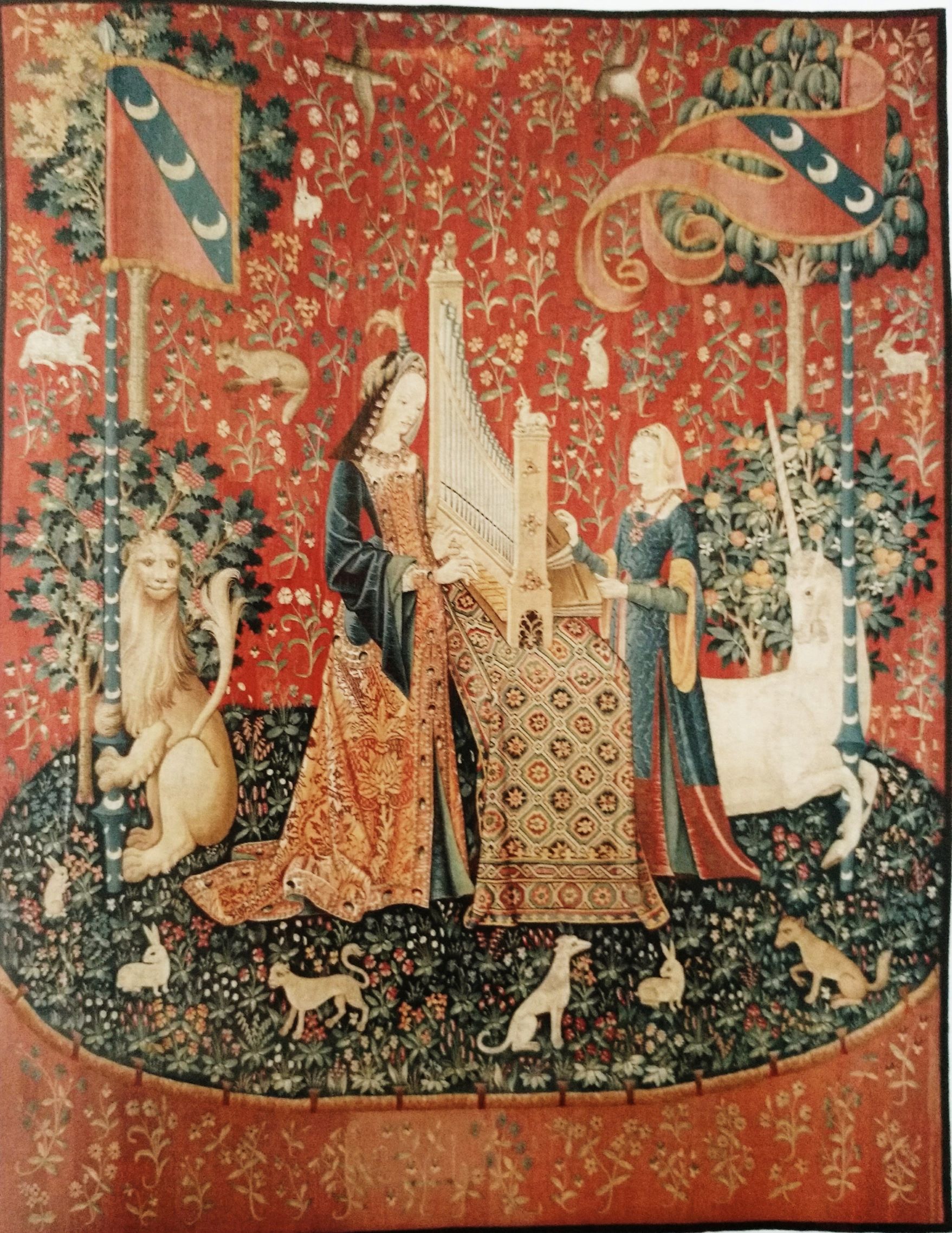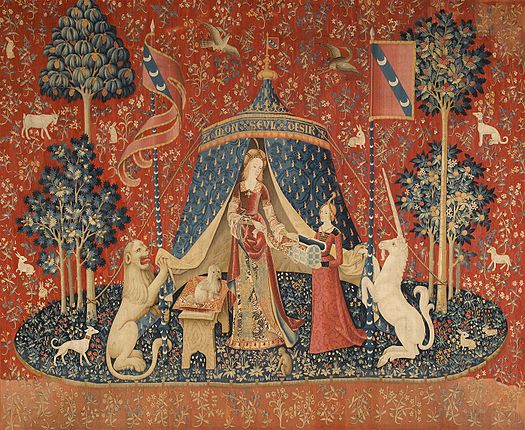
In the historic Latin Quarter, you will find a small jewel of a museum dedicated to the Middle Ages. There, among the many medieval objects exhibited, you will be able to admire what I believe is the finest treasure housed at the Cluny Museum: the collection of six Flemish tapestries known as the series of The Lady and the Unicorn. This collection is considered to be a masterpiece of 15th century tapestry weaving, with its amazing colors, fantastic designs and the mystery of its meaning.
The generally accepted interpretation of five of the tapestries is that they represent the five senses: sight, taste, hearing, smell and touch. The sixth tapestry, however, depicts a banner over the entrance to a tent with the words “À mon seul désir” (At my sole desire) and the meaning of this tapestry is open to debate. The lady is standing in front of the tent – is she leaving the tent or entering it? She has a necklace in her hand, is she putting it in the jewelry box or picking it up? Some have seen this tapestry as an expression of a sixth sense that in the middle ages was believed to be found in the heart; there are others who believe it speaks of love; other have seen an expression of understanding and intellect. There is also a religious interpretation whereby the lady renounces all earthly pleasures…
All six tapestries portray a beautiful woman, richly and elegantly dressed, and in four of them she is accompanied by a young woman, smaller in size, who is probably part of the lady’s court. The unicorn is always positioned to the left of the lady, and the lion to the right. The details of the clothes, jewelry and headdresses, as well as of the many animals and flowers shown, is amazing.
In the tapestry representing Taste, the lady takes some sweets offered by the young woman and the monkey at her feet is also eating them. In the one representing Hearing, the lady is playing a portable organ and the young woman is standing in front of her. The one dedicated to the sense of Sight shows us the lady sitting down, holding a mirror in which the unicorn is gazing at himself. The other animals in the background are also looking at each other.
The tapestry dedicated to Smell portrays the lady making a necklace with flowers that are being offered by the young woman. The monkey also appears in this tapestry, smelling the flowers. In the Touch tapestry, the lady is standing, stroking the horn of the unicorn with one hand and holding a banner with the other.
And then, finally, we have the sixth tapestry, open to various interpretations as I mentioned before. In this tapestry the lion and the unicorn hold the curtains of the tent’s door open… we don’t know if she will enter the tent or if she has just stepped out of it.
If you happen to be in Paris, I strongly recommend that you visit the Cluny Museum and then try to interpret the sixth tapestry on your own.
 Nora's Blog... Sixty and Still Going Strong!!